
Fractions, decimals and percentages can express the same proportion in different ways. Recognising equivalent forms helps, but understanding the whole is just as important. Twenty per cent of one amount is not necessarily equal to twenty per cent of another.
Use these worked examples for untimed practice before applying the limit of a particular task.
Connect common equivalents
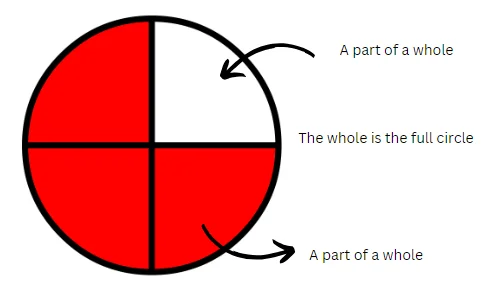
- 1/2 = 0.5 = 50%
- 1/4 = 0.25 = 25%
- 3/4 = 0.75 = 75%
- 1/5 = 0.2 = 20%
- 1/8 = 0.125 = 12.5%
A fraction represents numerator divided by denominator. A percentage expresses a proportion per hundred. For example, 1/4 equals 25/100, so it is 25%. A diagram split into equal parts can connect the notation with the quantity.
Add fractions using equal-sized parts
A pupil spends 1/4 hour on one task and 1/6 hour on another. How long altogether?
Rewrite the fractions in twelfths: 1/4 = 3/12 and 1/6 = 2/12. The total is 5/12 hour, or 25 minutes. Adding the denominators to obtain 2/10 would not preserve the sizes of the parts.
Check another way: a quarter-hour is 15 minutes and a sixth of an hour is 10 minutes. Their sum agrees with the fractional calculation.
Find the amount remaining
A reader has finished 2/3 of a 90-page book. The unread portion is 1/3, so 30 pages remain. Alternatively, calculate 60 pages read and subtract that from 90.
A correct intermediate answer may answer the wrong question. Label “read” and “remaining” before choosing an option.
Successive percentages use changing bases
An item costs $800. Its price decreases by 15%, then the reduced price increases by 25%. What is the final price?
After the reduction: 800 × 0.85 = $680. After the increase: 680 × 1.25 = $850.
It is not a simple 10% increase on $800. The 15% decrease and 25% increase apply to different amounts. Write the base beside each calculation to keep that distinction visible.
Exact values and estimates are not interchangeable
One third is exactly 1/3, but its decimal expansion continues as 0.333… . Writing 0.33 is an approximation. Three lots of 0.33 give 0.99, while three lots of 1/3 give exactly one.
Keep a fraction exact through intermediate steps when practical. Round at the point requested by the question, and state the requested precision. For example, 1/3 as a percentage is approximately 33.3% to one decimal place.
Estimate to check, not to manufacture certainty
Since 1/8 is 12.5% and 1/6 is approximately 16.7%, 1/7 lies between them. That range can reject an option such as 25%, but may not distinguish several closely spaced options. Calculate more precisely when the choices require it.
The instructions determine whether approximation is acceptable and how unanswered questions are treated. Do not assume one provider's rules apply to every assessment.
Continue with number fundamentals and translating numerical relationships, or browse practice tests.