
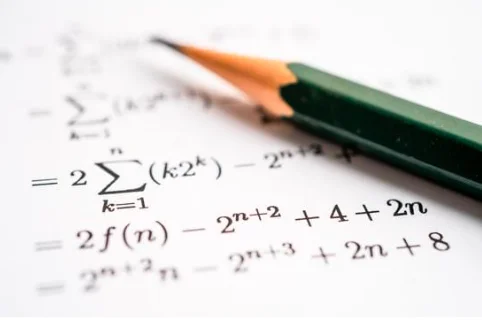
A multi-step calculation is easier to check when each line shows one clear operation. Before adding time pressure, help your child explain why that operation comes next. Knowing a rule and applying it consistently are different parts of practice.
These examples introduce useful number skills for Year 5 and Year 6 preparation. They are not an official syllabus or a prediction of a particular entrance paper.
Order of operations: equal priority matters
Work inside brackets first, then evaluate powers where present. Multiplication and division have equal priority and are evaluated from left to right. Addition and subtraction also have equal priority and are evaluated from left to right.
For 18 ÷ 3 × 2 + 4, first calculate 18 ÷ 3 = 6, then 6 × 2 = 12, then 12 + 4 = 16. Multiplying 3 by 2 first would change the expression. A mnemonic such as BODMAS must not be interpreted as “all division before all multiplication”.
For 2 + 3 × (4 − 1), the brackets give 3, multiplication gives 9, and addition gives 11. Copy unchanged parts carefully between lines.
Factors and multiples are different
The positive factors of 12 are 1, 2, 3, 4, 6 and 12: each divides 12 without a remainder. Positive multiples of 12 begin 12, 24, 36, 48. Factors divide into a number; multiples result from multiplying it by integers. Zero is also a multiple, though lists of positive multiples start above zero.
A prime number is an integer greater than one with exactly two positive factors: one and itself. Two is prime; one is not. These distinctions help when simplifying fractions and recognising number patterns.
Negative numbers: use the operation, not a slogan
For −3 − 2, move two places further left on a number line to get −5. For −3 − (−2), subtracting negative two is equivalent to adding two, giving −1.
Subtracting a negative number does not guarantee a positive result. It increases the starting value, which may still be below zero. The phrase “two negatives make a positive” is not a general rule for every expression containing negative signs.
Worked problem: find a missing value from a mean
Five daily attendance counts have a mean of 35. Four counts are 40, 30, 33 and 35. What is the fifth?
The total must be 5 × 35 = 175. The known counts sum to 138. The missing count is 175 − 138 = 37. Check by adding all five counts and dividing by five.
Worked problem: label what the division finds
Twenty boxes each contain 36 bars. If each volunteer receives five bars, how many volunteers can receive a full allocation?
There are 20 × 36 = 720 bars. Dividing by five bars per volunteer gives 144 volunteers. The wording must specify what each person receives; merely saying “groups of five volunteers” would not establish the number of bars allocated to each group.
Choose practice from the error
If the order is wrong, revisit the operations. If a copied value changes, slow down the working. If the answer has the wrong meaning, label each intermediate quantity. These require different fixes.
Continue with fractions, decimals and percentages, word problems or number patterns. Find samples through QASMT and BSHS.