
Before selecting a formula, identify what is being measured. Perimeter is a distance around a boundary. Area measures a two-dimensional region. Volume measures three-dimensional space. The same dimensions can be used in different calculations, so the question determines the operation.
These original worked examples use metric units. Use stated dimensions, not the apparent size of an illustration that may not be drawn to scale.
Perimeter: add the boundary lengths
A rectangular garden is 12 m long and 7 m wide. Its perimeter is 12 + 7 + 12 + 7 = 38 m, or 2 × (12 + 7).
If a 2 m opening is left for a gate, the remaining boundary requires 36 m of fencing, assuming one continuous fence around the rest and no extra allowance. The complete garden perimeter is still 38 m. The opening changes the amount of fencing, not the dimensions of the rectangle.
Check whether the question asks for the whole boundary or only part of it.
Area: count square units
The same garden has area 12 × 7 = 84 m². This measures the region inside, not the length of fencing. Multiplying metre lengths produces square metres.
A rectangle with a different shape can have the same perimeter but a different area. For example, 10 m by 9 m also has perimeter 38 m, but its area is 90 m². Perimeter alone does not determine a rectangle's area.
Worked border problem
A rectangular courtyard measures 18 m by 12 m. A path 1 m wide runs inside all four edges. Find the path's area.
The outer area is 18 × 12 = 216 m². The inner rectangle loses one metre at each end of both dimensions, so it measures 16 m by 10 m. Its area is 160 m². The path's area is therefore 216 − 160 = 56 m².
Subtracting only one metre from each overall dimension would miss the opposite edge. Adding four full-length strips can count the corner regions twice. Subtracting the inner rectangle avoids that overlap.
Volume: include the third dimension
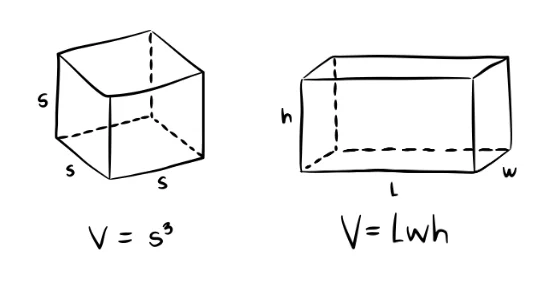
A rectangular box has internal dimensions 8 cm by 4 cm by 6 cm. Its internal volume is 8 × 4 × 6 = 192 cm³. A base layer covers 32 cm²; six centimetres of height gives 192 cubic centimetres.
If the given measurements were external, that calculation would give external volume rather than exact internal capacity. Read whether wall thickness or internal dimensions matter.
A cube with side 5 cm has volume 5 × 5 × 5 = 125 cm³. Multiplying only two sides gives a face area, not volume.
Convert units before combining dimensions
A rectangle is 2 m long and 50 cm wide. Convert the width to 0.5 m to obtain area 2 × 0.5 = 1 m². Alternatively, use 200 cm × 50 cm = 10,000 cm².
Because 1 m = 100 cm, one square metre contains 100 × 100 square centimetres. Area conversions require a squared factor; volume conversions require a cubed factor.
A final check
Ask: have I measured the boundary, the region or the space? Are all dimensions in consistent units? Does the answer use m, m² or m³ as appropriate? For composite shapes, check for missing or double-counted regions.
Sketch and label shapes during practice. Follow the particular test's instructions about working materials. Continue with word problems or number fundamentals, and find samples through QASMT or BSHS.